
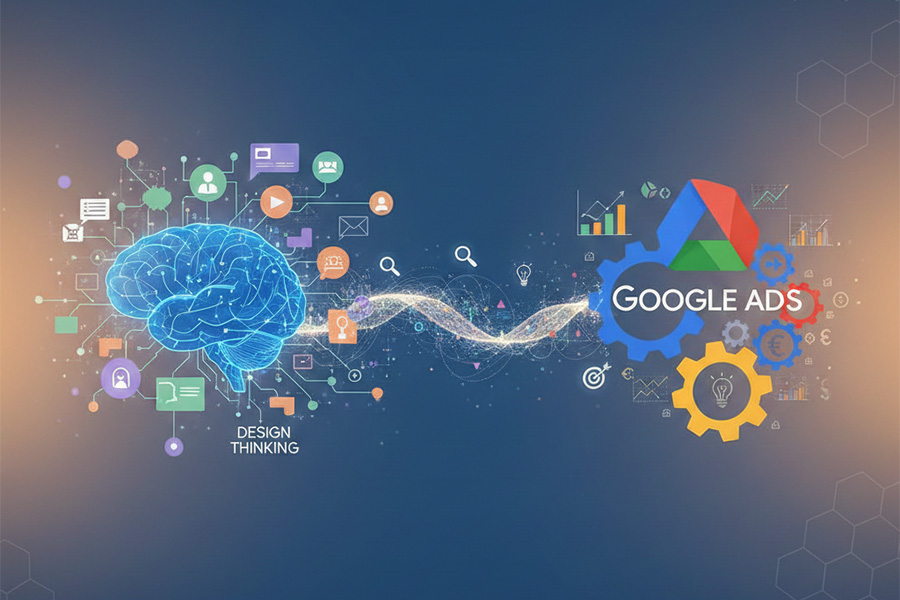
With Marketing, It’s No Longer Just Exposure Nowadays, it is not about exposure. It’s a matter of, can you understand people and can you help to solve their problems and guide them to a decision? And that’s right where design thinking can cast its spell. Instead of attempting to try to anticipate what users want, design thinking can help marketers build websites and digital ads around actual human needs.
We are going to demystify design thinking and explore how it can help you optimise your website, google ads services / PPC campaigns as well as your brand. You’ll learn what design thinking is, how the design-thinking process runs and why it leads to better conversions and savvier marketing decisisons.
Bringing Design Thinking to the Digital Advertising World
Design thinking is not something that’s only for product design or UX teams anymore. It’s actually a useful tool to help you plan the type of websites and ads you need in digital marketing today.
At its core, design thinking is about helping brands stop guessing and start listening.
What Is Design Thinking and Why Does It Matter Online?
Design thinking is a person-centric approach to problem solving. It’s not product or campaign driving anymore, it’s people. Every judgment is a feat of their wants, complaints, desires and behaviour.
In digital marketing, that’s huge, because there is no end of choices available to users. Give an address any reason to squirm or wriggle and folks scramble away in seconds.
Design thinking itself answers questions like:
- Why are people clicking but not converting?
- What the visitor is actually trying to solve for?
- What it is that they need to know before taking an action?
- Why does one ad message outperform another?
By focusing on these questions, marketers can develop an experience that feels more like discovery than disruption.
Converting design theory into practice in websites and Google Ads campaigns
If successful, design thinking would revolutionize the way websites and advertisements are created.
That’s what people use it for. Brands don’t make pages for trends; they make them based on how users actually use it. Marketers are writing copy that’s a closer match to the way customers actually think and talk, instead of how they think and talk about their own business.
For websites, this means:
- Clear structure
- Simple navigation
- Search content that answers REAL questions
- Powerful calls to action that make you want to get the offer
For Google Ads and PPC campaigns, that’s:
- Ads that match user intent
- Search-tied landing pages
- Test out ideas based on behavior, not assumption
- Continuous improvement through data
Design thinking turns marketing from a game of experimentation into an exercise in discovery and refinement.
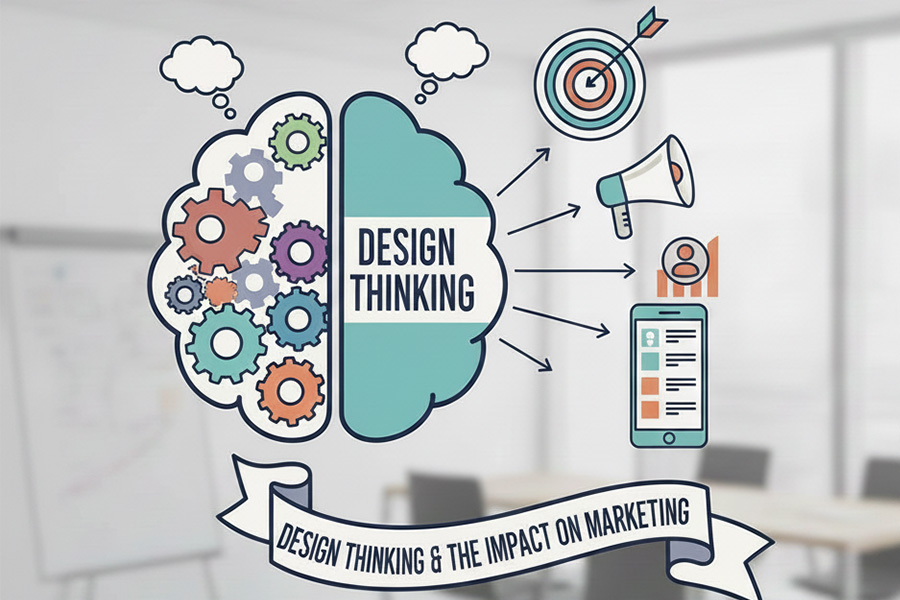
Design Thinking: Marketing in the New Era
Marketing design thinking means designing journeys, not just campaigns. It connects your branding together, messaging, ads and website experience into one flowing whole.
Design Thinking: User Focused Approch to Problem Solving
Behind every marketing campaign is a problem. It may be under-performing conversions, low engagement, high bounce rates or a lack of brand trust.
Design thinking comes along and looks at those issues and says,
- Who is the user?
- What are they trying to do?
- What’s holding them back?
- How can we remove friction?
This same puts the relationship and less about what you want for them as a brand. Users are more likely to respond well if they feel like they’ve been listened to.
5 Design Thinking Core Principles to Improve Your Websites and PPC results
Some rules can readily be applied to digital marketing:
- Empathy vs. presumption : Marketing decisions should operate under real insight as opposed to thoughts up the wazoo.
- Clarity wins over complexity: Simplicity and simpler designs get better results than complex ones.
- Testing, not perfection: Rather than waiting for the perfect idea, design thinking encourages rapid testing.
- Successive once-ons : A place in which campaigns develop and that’s in response to feedback and data.
- Consistency across touchpoints: Your ads, landing pages and branding should all tell the same story.
Such standards also make it easier for users to have repeatable experiences, taking people straight from ad to action.
Why You Campaign Better When You Think Like a Designer, Not Just a Candidate
Guesswork leads to wasted budgets. Design thinking is risk reduction with feedback and evidence.
Marketers who assume also risk:
- Targeting the wrong audience
- Highlighting the wrong benefits
- Using confusing language
- Designing pages that don’t meet users’ needs
Design thinking takes problem-solving away from guessing and moves it toward rigorous pedagogy. Every test teaches something. Every result makes the next decision easier.
Design Thinking For High Turning Websites & Google Ads
The process of design thinking has five key steps. The same is true for your website and PPC efforts.
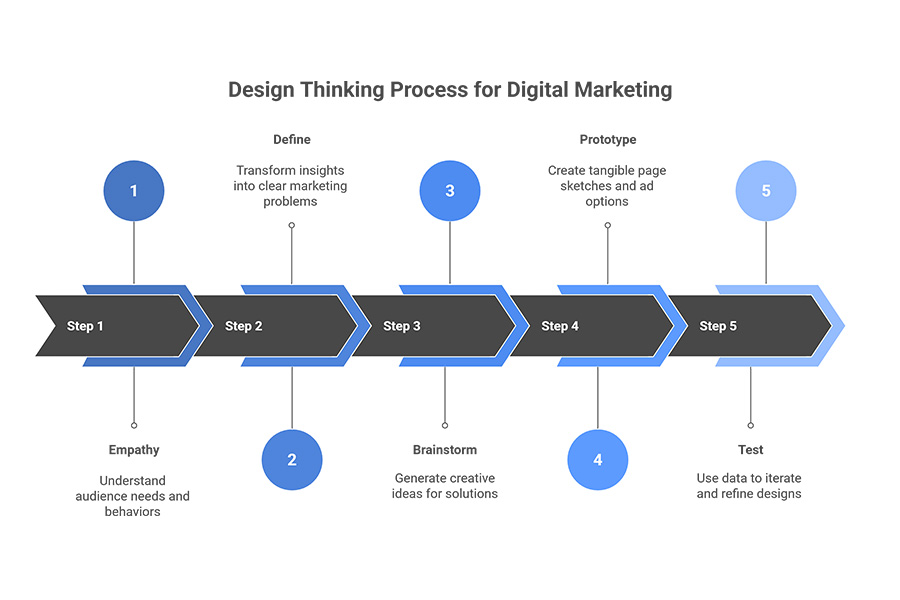
Step 1 – Empathy in Design Thinking Process, (Knowing your audience)
Empathy is knowing who your audience are as people, not a collection of demographics. This is where we need to be into the mindset, heart and lifestyle of end-users.
The new definition of empathy in digital marketing:
- Search queries
- On-site behavior
- Heatmaps and recordings
- Ad engagement data
- Customer feedback
- Support tickets and FAQs
So, say someone is looking for cheap digital marketing services then they are likely going to be price sensitive and cautious. This doubt should be addressed head-on in your landing page.
Empathy is the one that assures your message truly touchs the real user desires.
Step 2 – DEFINE: Turning User Insights into Specific Marketing Objectives
As soon as you know who the users are, you want to clarify the problem.
Examples:
- People click on ads but leave because the pricing methodology is opaque
- The visitors don’t trust the brand due to no proof.
- It’s hard for mobile users to see page layouts
- Ads attract the wrong sorts of visitors
Clear definition of the problem and focus leads to goal oriented solutions.
Step 3 – Write Out Your Brainstorm of Cool Ideas for LPs and Ad Copy
Ideation is a place where creativity borders on strategy. Given the focused problem, teams brainstorm ideas with no holding back.
- For marketing, this could include:
- New headings addressing user pain points
- Alternative calls to action
- Different value propositions
- Simplified page layouts
- New ad angles or offers
At this point, amount is more important than perfection. The aim is to explore freely.
Step 4 – Prototype: Page Sketches And Ad Options
Prototyping is the process of realizing even a small piece of an idea in something tangible to see and feel.
In the world of digital marketing, these could be:
- Wireframes for landing pages
- Draft headlines and copy
- Ad creatives and formats
- Simple page mockups
These can be raw first drafts, and don’t need to be polished. They are meant to be tested and improved upon.
Prototyping forces a team to move rather than bicker forever.
Step 5 – Test: The use of Google Ads data in iteration the Design Thinking Process
Testing is where design thinking derives all its power.
A/B Test for Google Ads and PPC should include:
- A/B testing landing pages
- Comparing ad copy variations
- Testing audiences and keywords
- Conversion and bounce rates analysis
This data shows what users are responding to. Marketers continue to iterate their concepts based on what they learn.
This test and learn cycle results in incremental, sustainable improvements.
How Goognetic Applies Design Thinking In Creating Performance Driven PPC Campaigns
At Goognetic (as a PPC agency) design thinking is in the heart of every campaign we do, plan and optimize. We do not merely base our ads on assumptions — we have an audience insight, and follow their journey at every step.
Our approach includes:
- Deep audience research
- Brief campaign requirements
- Ad messaging that scales with intent
- User-focused landing pages
- Continuous testing and optimization
- Transparent reporting and insights
Now, when we marry design thinking with performance metrics, we have PPC campaigns that are both efficient and scalable with impactful results.
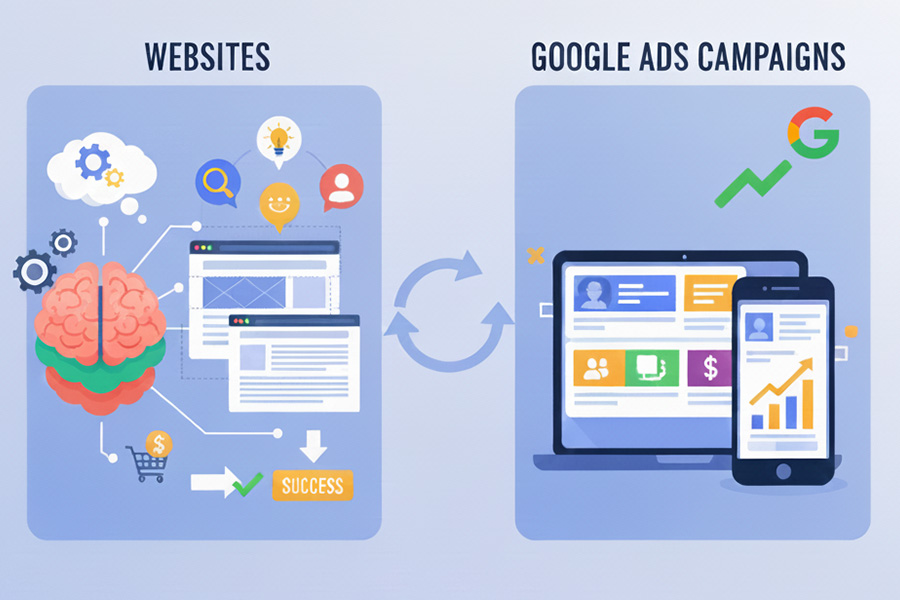
Draw Inspiration from Design Thinking for Your Next Promotion
You don’t need a large team or fancy tools to do design thinking. It can be phased in gradually.
Quick Checklist to Apply Design Thinking on Your Web Site & Google Ads
Before you launch or optimize a campaign, inquire:
- Who is my user and what are they trying to achieve?
- Is my ad message consistent with their intent?
- Do I have a clear and pared down landing page?
- How fast does the page answer FAQs?
- Am I trying out several ideas or fixating on one?
- Do I use data to make better decisions?
This checklist acts as a way to keep campaigns user-focused.
Set Yourself Up to Run Experiments or A/B Tests
You need:
- Clear goals and KPIs
- Proper conversion tracking
- Sufficient traffic for data collection
- One factor was investigated at one time
- Patience to run the tests for long enough
Good preparation ensures reliable insights.
Want Higher Conversions? Design Thinking and Your PPC Process
Design thinking enables you to stop reacting and start adapting with intention. Makes it a disciplined system for PPC, as opposed to taking wild guesses.
Conversions organically increase when you work campaigns from occasional users around.
Get Your FREE Audit to See How Design Thinking Can Help Increase your Campaign Success!
If your website or Google Ads are under-performing it is time to try a new approach. Through an audit informed by design thinking, you’ll recognize where users are having issues and how to solve them.
Ask us how small changes can make huge differences!
FAQ
- What is the concept of ‘design thinking’ in layman’s terms?
A technique for problem solving through an understanding of users rather than making assumptions. - What does design thinking have to do with marketing?
It also makes websites and ads clearer, more relevant and user-friendly. - Is design thinking something that can be applied to PPC?
Yes, it includes ad copy, landing pages and testing. - What’s the process?
Empathize, define, ideate, prototype and test. - Does it improve conversions?
Yes, if you eliminate friction and get in sync with user intent, conversions WILL naturally increase.

